
The Backdoor Roth: What It Is, Who Needs It, and How to Do It Right

If you've ever looked into contributing to a Roth IRA only to find out your income is too high, you may have hit a wall. The good news: there's a perfectly legal workaround called the backdoor Roth. This post breaks down exactly what it is, whether it applies to you, and the one pitfall you absolutely need to avoid.
First, a Quick Refresher
A Roth IRA is one of the most powerful retirement savings tools available. You contribute after-tax dollars, your money grows tax-free, and qualified withdrawals in retirement are completely tax-free. The catch: the IRS limits who can contribute directly based on income. For 2026, the ability to contribute phases out for single filers between $153,000 and $168,000 MAGI, and for married couples filing jointly between $242,000 and $252,000. Above those thresholds, a direct Roth contribution is not allowed.
If you are under those limits, great! - contribute directly and stop reading here. The backdoor Roth is for those who earn too much to contribute the traditional way.
Who Should Consider a Backdoor Roth
The backdoor Roth is worth considering if:
- Your income exceeds the Roth IRA limits above
- You have already maxed out your workplace retirement plan (401(k), 403(b), etc.)
- You want additional tax-free growth in retirement
- You do not have significant pre-tax IRA balances (more on this to follow)
Who Does Not Need to Bother
If your income falls below the Roth phase-out thresholds, simply contribute directly to a Roth IRA. There is no advantage to doing it the backdoor way, and it adds unnecessary complexity.
As for your workplace 401(k), at minimum contribute enough to capture your employer match. That is free money you do not want to leave on the table. Beyond that, contributing to an IRA outside of your 401(k) can actually offer more flexibility, including broader investment choices and easier access to your money. It does not have to be one or the other.

How It Works: Step by Step
The backdoor Roth is actually a two-step process and is simpler than it sounds.
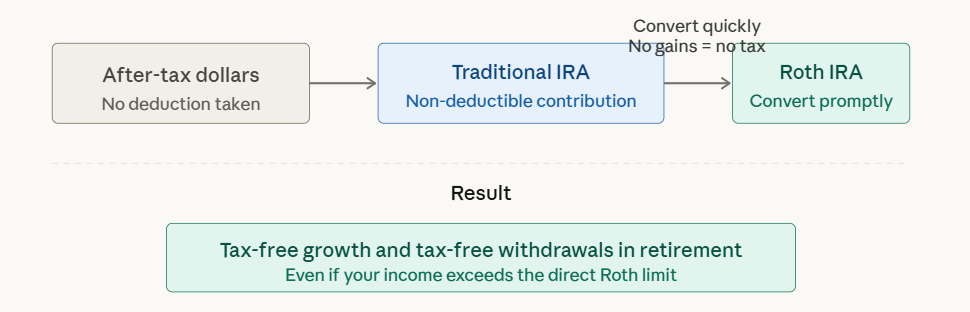
Step 1: Make a Non-Deductible Traditional IRA Contribution
Contribute to a traditional IRA but do not take a tax deduction. You are contributing after-tax dollars, just as you would with a Roth. For 2025, the limit is $7,000 ($8,000 if you are 50 or older by December 31, 2025). For 2026, $7,500 ($8,600 if you are 50 or older).
Step 2: Convert It to a Roth IRA
Shortly after your contribution is deposited, ideally within a few days, convert the traditional IRA to a Roth IRA. Because you already paid tax on those dollars and the account has had little to no time to earn any gains, the conversion should have little to no tax consequence. Your brokerage will walk you through this process and it is typically done online in just a few clicks.
That's it. The key is moving quickly so the account does not accumulate gains before conversion, which would be taxable.
The One Pitfall You Must Avoid: The Pro Rata Rule
Here is where things can go sideways, and it catches a lot of people off guard.
The IRS does not look at your backdoor Roth contribution in isolation. It looks at the total value of all your pre-tax IRA assets when calculating how much of your conversion is taxable. This is called the Pro Rata Rule, and it applies to:
- Traditional IRAs
- Rollover IRAs (funds rolled over from a former employer's 401(k))
- SEP IRAs
- SIMPLE IRAs
It does not apply to 401(k) or 403(b) balances.
Here is a simplified example of how it works. Suppose you have $93,000 sitting in a rollover IRA from a previous job and you contribute $7,000 to a non-deductible traditional IRA for your backdoor Roth. The IRS sees a total of $100,000 in IRA assets, of which only $7,000 (7%) is after-tax money. When you convert, only 7% of the conversion is tax-free. The other 93% is treated as taxable income, defeating the entire purpose of the strategy.
The bottom line on the Pro Rata Rule: if you have any pre-tax IRA balances, the backdoor Roth may not work as cleanly as you expect.
Before proceeding, talk to your financial advisor or CPA. In some cases, rolling your pre-tax IRA funds into a current employer's 401(k) can clear the way for a clean backdoor Roth conversion; but this requires planning.
A Few More Things to Know
- The backdoor Roth is an annual strategy. You can do it each year as long as the rules remain in place.
- There is no income limit on conversions. The limit only applies to direct Roth contributions.
- You must have earned income equal to or greater than the amount you are contributing. Pension income, Social Security, interest, and dividends do not count.
The Bottom Line
The backdoor Roth is a smart, legal strategy for high earners who want access to tax-free growth in retirement. Done correctly and quickly, there should be little to no tax consequence. But the Pro Rata Rule is a real and often overlooked complication that can turn a clean strategy into a tax headache. Know your IRA balances before you act, and when in doubt, work with an advisor.
Want to know if you're eligible to contribute directly to a Roth, or whether a backdoor Roth makes sense for your situation? Check out our newsletter article on 2025 IRA contribution limits and deadlines [link] or reach out directly.
This blog post is intended for educational and informational purposes only. The views expressed are solely those of the author and do not represent professional financial advice. While every effort has been made to ensure the accuracy of the information presented, it should not be relied upon as a substitute for individualized advice from a qualified financial advisor. Financial decisions are complex and personal, and readers are strongly encouraged to conduct their own due diligence and seek professional guidance before making any investment or financial planning choices.
- Chris Maggio, Founder, Retirement Planning Partner, Kirkland, WA—providing fee-only retirement planning to clients in Seattle and across the US.