
Why I Changed My Mind About International Investing

For a long time, I was a U.S.-only investor. And I had what felt like a perfectly reasonable argument: I owned large U.S. companies with massive international operations. Coca-Cola sells everywhere. Apple sells everywhere. Why did I need anything else?
The more I thought about it, and the more interconnected the world became, the more that argument started to feel like a comfortable excuse rather than a real strategy. Here's what changed my thinking.
Let's Be Honest: International Has Been a Drag
I'm not going to sugarcoat this. If you've held international stocks over the past decade, you've felt the frustration. The S&P 500 averaged 13.8% in annualized returns over the past 10 years, while global stocks averaged 4.9%. That's a significant gap, and it's hard to stay patient with an allocation that seems to be slowing you down year after year.
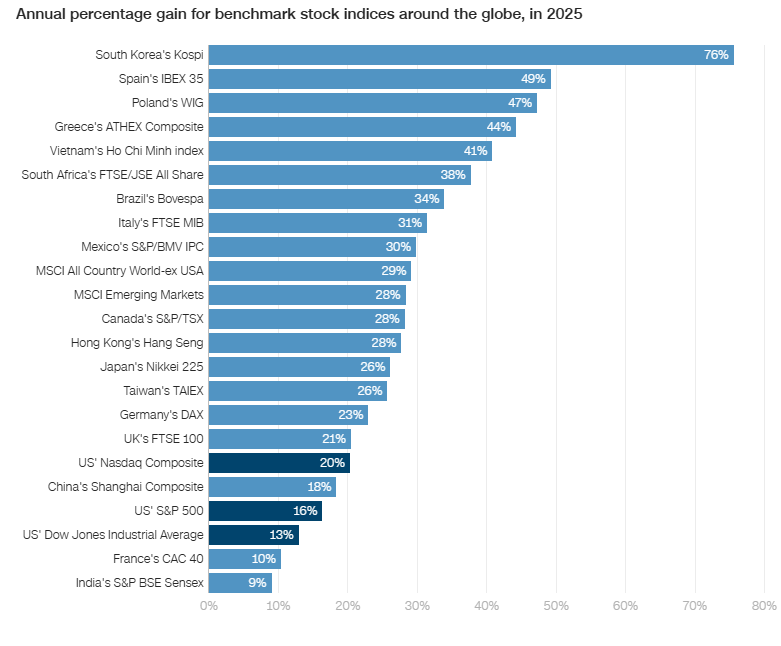
But here's the thing about markets: they move in cycles, and they tend to humble investors who declare one approach permanently superior. Since 1975, the outperformance cycle for U.S. versus international stocks has lasted an average of more than eight years, and we spent about 14 years in a cycle of U.S. dominance. In 2025, international stocks finally changed the tides. The investors who held on and didn't abandon the allocation were rewarded.
Cycles end. They always have.
The Companies You're Missing
When I say "invest internationally," I'm not talking about obscure companies in distant markets. I'm talking about some of the most dominant businesses on the planet, businesses you may never own if you limit yourself to U.S. exchanges.
Taiwan Semiconductor (TSMC) manufactures the chips that power nearly every advanced device in the world, including the ones made by Apple, Nvidia, and AMD. ASML, a Dutch company, holds a near-monopoly on the extreme ultraviolet lithography machines that chipmakers use to produce the world's most advanced processors, machines that TSMC, Samsung, and Intel all depend on. Novo Nordisk, based in Denmark, is the company behind Ozempic and Wegovy, drugs that have reshaped the conversation around diabetes and obesity treatment globally. LVMH is the world's largest luxury goods conglomerate, home to Louis Vuitton, Christian Dior, Tiffany, and Hennessy, among many others. SAP, AstraZeneca, Nestlé, Hermès, Airbus and the list goes on.
These are world-class companies with durable businesses. They just happen to be headquartered outside the U.S. A U.S.-only portfolio doesn't own any of them, and no amount of U.S. multinational exposure fully replicates that.
The Dollar Hedge and Why It Matters More Than People Think
This is the part that doesn't get enough attention. When you own international investments, you're not just buying exposure to foreign companies. You're also holding assets denominated in foreign currencies. And when the U.S. dollar weakens, that works in your favor in a very direct way.
Here's a simple example: say you purchase €10,000 worth of European stock when the exchange rate is €1:$1, paying $10,000. One year later, the stock's value is unchanged at €10,000, but the exchange rate has moved to €1:$1.15. With the dollar weaker relative to the euro, your investment is now worth $11,500, just from the currency shift. The underlying investment didn't move. The dollar did.
This matters because the U.S. dollar doesn't always strengthen. Deficits, monetary policy, geopolitical shifts, any number of factors can put pressure on the dollar over time. Owning only U.S. assets means your entire portfolio rises and falls with the dollar's strength. International exposure gives you a natural counterweight to that.
But Don't Overdo It
Vanguard research found that holding international equities at a 30 to 40% allocation optimally reduced volatility within a U.S. equity portfolio. That's a meaningful data point. It's not go all-in on international. It's have enough that it actually does something for your portfolio.
Too little and it barely moves the needle. Too much and you've introduced a different set of risks, currency volatility, geopolitical exposure, regulatory environments, without enough U.S. anchor to balance it. The allocation matters as much as the decision to invest internationally at all.
Where I've Landed
I used to think being invested in large U.S. companies with international operations was enough. I've changed my mind, not because the U.S. market is bad, but because the world genuinely is more interconnected than it used to be. The companies driving the next era of technology, healthcare, and consumer growth aren't all headquartered in the U.S. The risks to a dollar-heavy portfolio are real. And the cycles that made international look like a drag for a decade have a way of reversing when you least expect it.
A portfolio built only on what has worked recently isn't a strategy. It's a bet. Adding international exposure, thoughtfully and at the right allocation, is one of the more straightforward ways to build something more resilient, not just for the world as it is today, but for the one we're moving into.
This blog post is intended for educational and informational purposes only. The views expressed are solely those of the author and do not represent professional financial advice. While every effort has been made to ensure the accuracy of the information presented, it should not be relied upon as a substitute for individualized advice from a qualified financial advisor. Financial decisions are complex and personal, and readers are strongly encouraged to conduct their own due diligence and seek professional guidance before making any investment or financial planning choices.
- Chris Maggio, Founder, Retirement Planning Partner, Kirkland, WA—providing fee-only retirement planning to clients in Seattle and across the US.