
Scaling: It Doesn't Need to Be All or Nothing

So often, investors live in a state of constant regret. They hold onto a position too long as it moves sideways or gradually downward, paralyzed by the hope of a rebound. Or they hesitate to add to a winning position because it's no longer at that "ideal" purchase price, eventually convincing themselves they've missed the boat entirely.
Here's the reality: if you consider yourself a long-term investor, you have to start behaving like one.
The Cost of Hesitation: An Apple Case Study
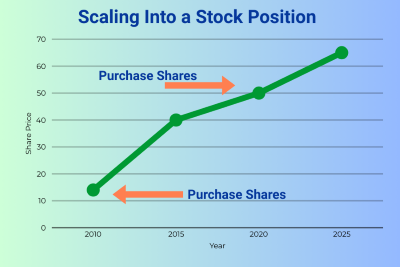
To understand the power of scaling, look at the actual numbers. On January 3, 2012, Apple was trading at a split-adjusted price of approximately $14.46 per share. If you had invested $10,000 then, you would have purchased roughly 691 shares.
At today's price of $244.56 (as of January 2, 2026), that initial $10,000 investment would be worth approximately $169,029.
But let's look at the second "missed" opportunity. If you had $10,000 in 2018, you might have looked at the price of $43.06 on January 2, 2018, and thought Apple was "too expensive now" because it had already tripled since 2012.
If you had pushed past that psychological barrier and invested that $10,000 in 2018, you would have bought 232 shares. Today, those shares alone would be worth $56,738. By waiting for a "dip" that never came, you didn't just miss a price point—you missed out on a 5.7x return on your capital.
The Opportunity Cost of "Some Hope"
The same logic holds true for the positions dragging you down. Many of us refuse to sell because we're waiting for them to "come back around." But while you wait, what's the opportunity cost?
Every dollar tied up in a "hope and pray" stock is a dollar that isn't working for you in a high-conviction growth engine. Why not scale out? You don't have to liquidate the entire position and admit total defeat. You can hold onto a smaller portion for "some hope" while being reasonable about reallocating that capital to fuel a different investment that actually has momentum.
What Is Scaling?
Scaling is the strategy of entering or exiting a position in increments rather than all at once.
Scaling In: Buying into a stock in pieces (e.g., $2,500 at a time rather than $10,000 all at once). This lowers the risk of poor timing and allows you to build a position as a company proves its worth.
Scaling Out: Selling a percentage of your holdings (e.g., 20% of a winner to lock in gains, or 50% of a loser to move capital elsewhere). It removes the binary pressure of being "all in" or "all out."
The Psychology: Why Is It So Hard?
If scaling is so logical, why do we struggle with it? It comes down to three main psychological hurdles:
- The Anchor Effect: We "anchor" our brain to the first price we saw. If we bought at $14, buying more at $43 feels like "ruining" our average, even if the company's future outlook is stronger than ever.
- Loss Aversion: Research shows that the pain of losing is approximately twice as powerful as the joy of gaining. We stay in bad trades because selling feels like "making the loss real," whereas holding feels like the loss hasn't "happened" yet.
- The "All or Nothing" Fallacy: Our brains prefer simple, binary choices. Scaling requires us to live in the "gray area" of being partially right and partially wrong. It requires the humility to admit we don't know exactly where the top or bottom is.
The Bottom Line
Scaling is the professional way to manage a portfolio. It turns emotional "gambling" into a mechanical process of risk management.
This blog post is intended for educational and informational purposes only. The views expressed are solely those of the author and do not represent professional financial advice. While every effort has been made to ensure the accuracy of the information presented, it should not be relied upon as a substitute for individualized advice from a qualified financial advisor. Financial decisions are complex and personal, and readers are strongly encouraged to conduct their own due diligence and seek professional guidance before making any investment or financial planning choices.
- Chris Maggio, Founder, Retirement Planning Partner, Kirkland, WA—providing fee-only retirement planning to clients in Seattle and across the US.